
If you're looking at a Shaker style kitchen, one of the biggest choices you'll make is the door finish: painted solid wood or a foil wrap. I get asked about this all the time, and there's a lot of confusion out there. The price difference is significant, so it's a decision worth getting right. As a kitchen manufacturer with over 20 years in the trade, I want to give you a straight, honest comparison, with no sales talk. I'll explain exactly what each type is, how they stack up on durability and appearance, and when each one is the right choice. My goal is to give you the facts so you can decide what's best for your home and your budget.
Painted vs Foil Kitchen Doors: An Honest Comparison
📋 Data Accuracy Notice — All specifications on this page are based on publicly available information as of 2026. We welcome manufacturers to submit updated specifications directly to info@sjball.uk — we’ll update our data within 48 hours. We’re committed to accuracy, and we’re happy to be checked.
Made to Order
Custom sizes available
Rigid Built
18mm throughout
Blum Soft Close
As standard
Nationwide Delivery
From 10 working days
What is a Painted Shaker Door?
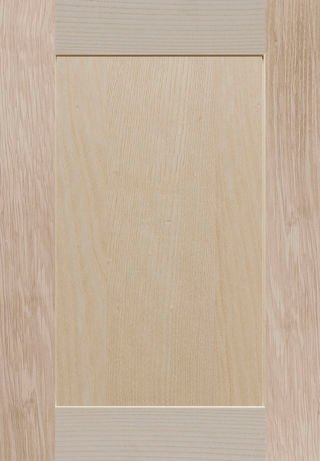
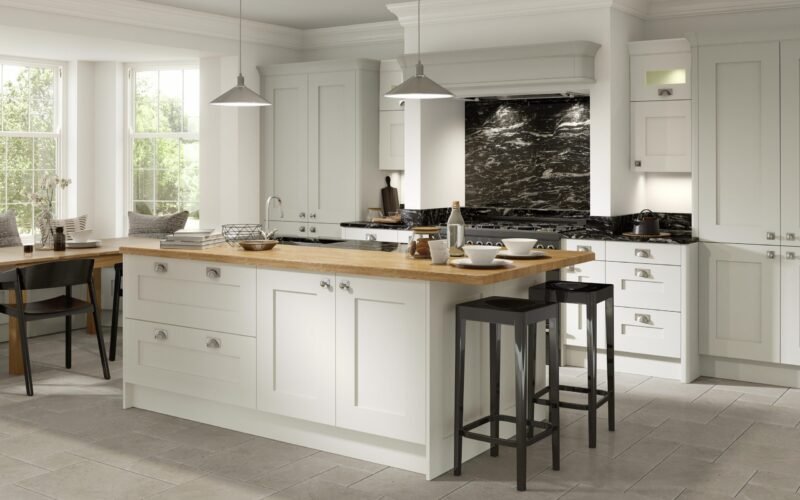
A 'painted' kitchen door from a specialist like us is exactly what it sounds like. We take a door made from solid wood and apply a high-quality, durable paint finish in a controlled factory environment. The door itself is a traditional 5-piece construction — that means it has a solid wood frame (the stiles and rails) and a central panel. This is the classic way of making a cabinet door, and it's stood the test of time for a reason.
The key thing to understand is that you're getting a real wood product with an authentic, sprayed-on paint finish. This gives it a premium feel and a depth of colour that's hard to replicate. You can often see the very subtle grain of the wood through the paint, which adds character and proves it's not a synthetic material. Because it's a solid material with a painted surface, it's also repairable. If you get a chip or a scratch down the line, it can be touched up or even fully repainted.
What is a Foil-Wrapped Door?
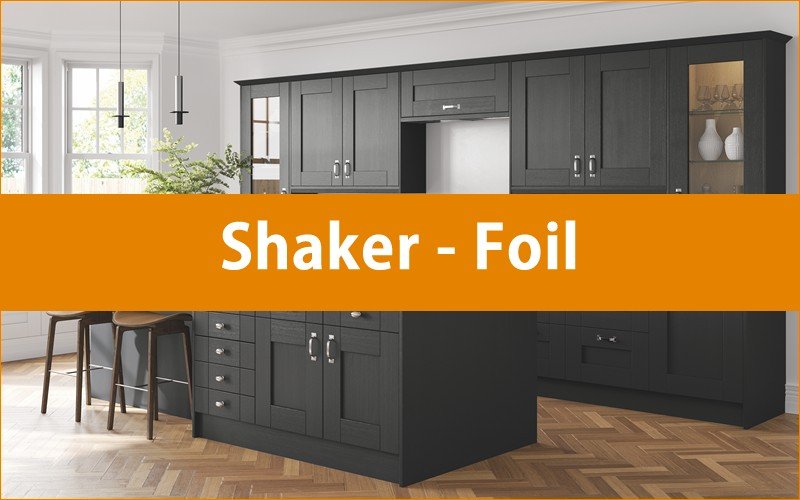
A foil-wrapped door, often just called a 'foil' or 'laminate' door, is made differently. The core of the door is MDF (Medium Density Fibreboard), which is then wrapped in a plastic foil. This foil is essentially a sheet of coloured, textured plastic that is bonded to the MDF to give it the appearance of a painted door. It's a very common way of making kitchen doors, especially at the lower end of the market.
This is a mass-production technique that allows manufacturers to create a consistent, uniform finish very quickly and cheaply. There's no painting involved. The quality of these doors has improved over the years, but the fundamental construction is the same. It's an MDF core with a plastic coating. The main drawback is that this plastic foil can be susceptible to peeling or 'delaminating' over time, especially when exposed to heat and steam from kettles, toasters, or ovens.
Durability & Repairability: The Key Difference
This is where the biggest difference lies, and it's what you're paying for with a painted door. A painted solid wood door is far more durable and is fully repairable. If you get a chip, you can sand it down and touch it up with a little paint. If in ten years you fancy a change of colour, you can have the whole kitchen professionally resprayed. It's a door for life.
A foil-wrapped door cannot be effectively repaired. Once the foil starts to peel away from the MDF core — and this is a common problem, especially with cheaper versions — there's no sticking it back on. Any damage to the foil surface, like a deep scratch or a dent, is permanent. The only solution is to replace the entire door. This is a critical point to consider. A kitchen is a high-traffic area, and wear and tear is inevitable. The ability to repair minor damage is a huge advantage for painted doors.
Appearance & Cost: Is Painted Worth The Extra?
There's no getting around it: painted kitchens cost more than foil kitchens. The raw materials (solid wood vs MDF) and the manufacturing process (spraying and finishing vs wrapping) are more expensive. But you can see and feel the difference. A painted door has an authenticity and a premium feel that foil can't match. The finish is richer, and the subtle wood grain adds a character that you just don't get from a plastic wrap.
So, is it worth it? In my opinion, yes, if it's for your own home and you plan to be there for a while. It's an investment in a kitchen that will last longer and look better for years to come. However, that's not to say foil doesn't have its place. If you're on a very tight budget, or you're renovating a rental property or a utility room, a foil-wrapped door can be a very sensible, cost-effective choice. Our Shaker Foil doors are a great product for the price, using the same high-quality rigid carcasses as our premium kitchens. It's just important to be honest about what it is, and what its limitations are compared to a painted door.

What Our Customers Say
REQUEST A FREE DESIGN & QUOTE
Made to Order & Delivered in 10 Working Days
Rigid Built Cabinets with Blum Soft Close as Standard
Nationwide Delivery Available
info@sjball.uk
0161 509 4221
